Introduction: When Sports Space Demand Collides with Traditional Construction Bottlenecks
With the explosive global growth of year-round, all-weather sports, professional clubs, youth academies, and commercial sports center investors face a critical initial question: What are the standard dimensions of an indoor soccer field, and how much ceiling clearance is required?
Traditional brick-and-mortar facilities often present immense hurdles—stifling capital requirements, multi-year construction timelines, and rigid permanent layouts that prevent quick adaptive changes. This guide provides a definitive breakdown of indoor soccer and futsal dimensions. Furthermore, it reveals how forward-thinking operators utilize high-efficiency, clear-span modular aluminum sports structures to build regulatory-compliant, premium indoor soccer complexes within weeks at a fraction of the cost.
1. Indoor Soccer vs. Futsal: Understanding the Key Technical Differences
Before mapping out your facility’s square footage, it is vital to distinguish between broad “indoor soccer” and official “futsal.” This decision dictates your subfloor engineering, turf selection, and safety perimeter layouts:
| Feature | Indoor Soccer Field | Futsal Court |
| Typical Size | Generally larger (e.g., 185′ x 75′ / 56.4m x 22.8m) | Compact (International match standard: 38m–42m × 20m–25m) |
| Playing Surface | High-grade Artificial Turf engineered for shock absorption | Hardwood or synthetic multi-sport court (Hard Surface) |
| Boundary Design | Enclosed by rebounding boards or walls; play continues off the wall | Standard painted lines; ball out of bounds results in a kick-in |
| Ball Type | Standard soccer ball (Size 4 or 5) | Low-bounce, heavier futsal-specific ball |
| Core Objective | Fast-paced commercial leagues, multi-sport turf rentals | FIFA-sanctioned competitive play, elite agility, and technical training |
2. Indoor Soccer Field Dimensions by Match Format
According to the United States Indoor Soccer Association (USISA) and international governing frameworks, pitch sizes scale depending on age brackets, player counts, and whether the facility serves recreational or professional purposes.
The U.S. & International Standard Indoor Pitch
- Standard Dimensions: 185 feet long by 75 feet wide (56.4 meters × 22.8 meters).
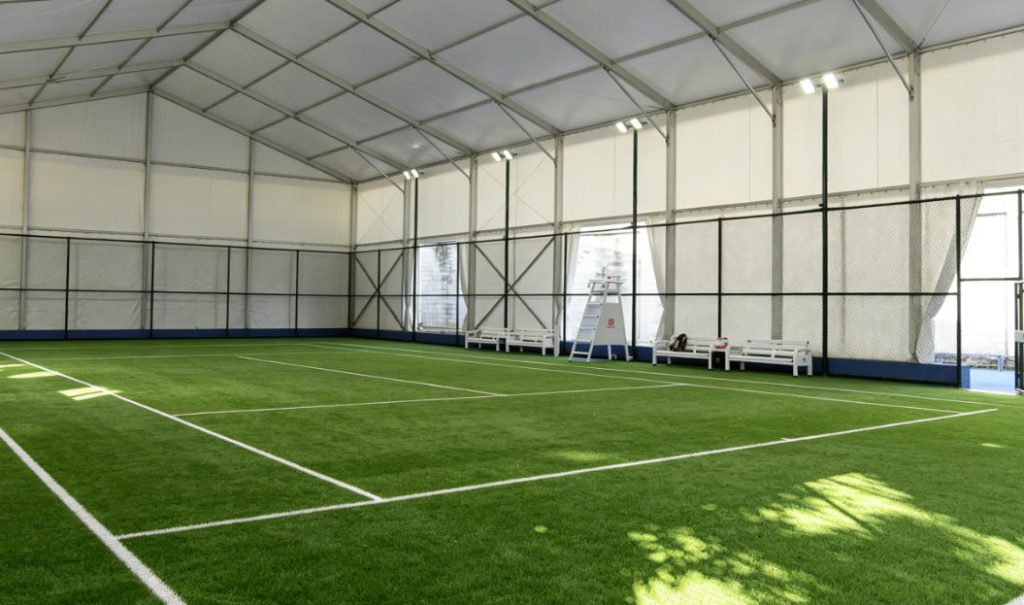
- Vertical Clearance Requirement: A minimum ceiling height of 20 feet (6 meters) is mandatory. This ensures high-clearance passes, chips, and goalkeeper punts do not interfere with overhead building components or fabric membranes.
- Spatial Allocation Warning: When calculating total facility square footage, operators must allocate an additional 15% to 20% beyond the field boundaries for substitution benches, penalty boxes, referee tracks, and immediate spectator buffers.
Standard Dimensions Across Various Match Types
To optimize land use and maximize revenue per square meter, consult this comprehensive sizing matrix for sports facility planning:
| Match Format | Recommended Length (ft / m) | Recommended Width (ft / m) | Minimum Ceiling Height | Target Application |
| 5v5 / Futsal | 82′ – 138′ (25 – 42m) | 52′ – 82′ (16 – 25m) | ≥ 16.4 ft (5m) | Youth academies, technical training drills, high-density commercial rentals |
| 7v7 Pitch | 147′ – 213′ (45 – 65m) | 98′ – 147′ (30 – 45m) | ≥ 20 ft (6m) | Adult amateur leagues, club-level team training camps |
| 11v11 Standard | 295′ – 394′ (90 – 120m) | 147′ – 295′ (45 – 90m) | ≥ 26.2 ft (8m) | Professional club centers, regional tournament hubs, stadium enclosures |
3. Visualizing the Space: Indoor Soccer vs. Other Sports Fields
When engineering a multi-purpose sports complex, comparing soccer layout demands against other sports helps operators master multi-sport zoning and maximize space utilization:
| Sport Facility Type | Standard Length (Yards / Meters) | Standard Width (Yards / Meters) | Spatial Volume Characteristics |
| Standard Indoor Soccer | 61 – 66 yds (56 – 61m) | 25 – 30 yds (23 – 27m) | Highly compact, fast-paced layout emphasizing perimeter rebounds. |
| American Football Field | 120 yds (110m) | 53.3 yds (49m) | Extremely linear footprint; requires vast span profiles and higher apex zones. |
| Standard Outdoor Pitch | 100 – 130 yds (91 – 119m) | 50 – 100 yds (46 – 91m) | Massive footprint; cost-prohibitive to cover with traditional permanent architecture. |
| Under-6 (U6) Youth Field | 25 – 35 yds (23 – 32m) | 15 – 25 yds (14 – 23m) | Highly modular; a single standard indoor field can be partitioned into multiple U6 zones. |
4. Four Critical Design Pillars for Modern Indoor Soccer Facilities
A highly profitable, top-tier indoor sports complex requires detailed engineering well beyond the boundaries of the white lines:
- Ancillary Service Zoning: Locker rooms, public restrooms, showers, a welcoming reception lounge, and a pro-shop retail corner should constitute roughly 15% to 20% of your total building footprint. These spaces drive client retention and secondary spend.
- Spectator Integration & Social Hubs: Modern complexes are social destinations. Incorporating elevated viewing platforms, a sports café, or parent seating perimeters dramatically increases dwell times and concessions revenue.
- Advanced Climate & Air Quality Control (HVAC): Due to the high-intensity cardiovascular nature of indoor soccer, facilities must feature robust ventilation systems capable of high air-exchange rates to regulate heat, control moisture, and prevent odor buildup.
- Anti-Glare Sports Lighting: Lighting must be uniform and shadow-free. Professional training facilities typically require 300 to 500 Lux, while tournament-grade fields with broadcasting capabilities demand much higher illuminance levels.
5. Why Clear-Span Modular Aluminum Structures are the Perfect Fit for Indoor Soccer
Once your layout and dimensions are set, the final hurdle is execution: How can you build a structure that satisfies these strict dimensions quickly and cost-effectively? Compared to conventional brick-and-mortar or rigid steel builds, KENTEN’s modular aluminum clear-span structures provide a revolutionary spatial solution:
100% Column-Free Clear-Span Space
KENTEN sports buildings feature zero interior support pillars. We deliver clear spans (widths) ranging from 3 meters up to 80 meters. This engineering marvel guarantees completely unobstructed sightlines and total movement safety. Players can sprint, clear balls, and execute high-arc lobs without any risk of hitting internal columns or building components.
Infinite Modular Scalability
Our structural lengths expand infinitely using 3-meter or 5-meter bays. This modularity allows your indoor soccer hall to fit perfectly within irregularly shaped land parcels. More importantly, if your club grows or membership demand spikes, you do not need to tear down the building; you simply add modular bays to expand the length of your facility.
Engineered for Extreme Weather & Long-Term Durability (20+ Years)
Constructed from high-strength, structural-grade extruded aluminum alloy (6061/T6) combined with heavy-duty, flame-retardant, UV-resistant, and waterproof PVC textile covers, KENTEN structures are built to endure. Our sports halls are precision-engineered to withstand high wind loads of 100-120 km/h. For colder climates, our engineering teams customize the aluminum profiles to support heavy regional snow loads, ensuring absolute safety year-round.
Simplified Permitting & 70% Faster Timelines
Because modular buildings are classified as temporary or semi-permanent structures, the regulatory permitting process is significantly less complex than traditional civil construction in most jurisdictions. All components are prefabricated in KENTEN’s advanced manufacturing plant and shipped ready for assembly. On-site installation takes only a few weeks, slashing local labor costs and getting your business up, running, and generating revenue months ahead of schedule.
6. Indoor Soccer Project Investment FAQ
Q: What is the average cost to build a commercial indoor soccer facility? A: Total costs depend on your foundation preparation, utility integrations, turf quality, and lighting setups. Traditional concrete-and-steel builds are capital-heavy and slow to execute. Choosing a KENTEN modular aluminum sports hall dramatically lowers the initial investment because it places minimal requirements on permanent foundations—it can anchor directly onto existing concrete, asphalt, or leveled ground. This optimization cuts overall structural and time expenses by more than 50%. Contact our engineering staff for a tailored project quote based on your land dimensions.
Q: How profitable is an indoor sports facility? What are the margins? A: Indoor sports centers are highly lucrative investments because they remove weather risks entirely, unlocking high-frequency operations 365 days a year. Diversified revenue streams include prime-time league rentals, youth club training contracts, corporate team-building events, soccer field birthday parties, and tournament hosting fees. Combined with ancillary revenue from food and beverage concessions, pro-shop sales, and field-side banner advertisements, a well-managed indoor soccer facility can realize net profit margins of approximately 43%, leading to a much shorter capital payback period compared to standard commercial real estate.
Q: Are modular structure roof heights sufficient for high-level soccer play? A: Absolutely. KENTEN’s specialized sports structures—including our A-Frame, Polygon, and Arcum designs—can be engineered with eave heights from 4 to 8+ meters. As the span widens, the apex height increases proportionally. At widths of 30 to 50 meters, the ridge height routinely reaches 10 to 15+ meters, comfortably exceeding the overhead clearance mandates enforced by FIFA and national indoor soccer associations.
Partner with KENTEN: Building World-Class Sports Infrastructure
A successful, high-performance sports venue destined to operate safely for over two decades requires an elite global supply chain and unimpeachable engineering authority.
Established in 2001, KENTEN (KENTEN Events Group LTD) operates a massive 50,000-square-meter modern manufacturing hub.
As a fully certified enterprise matching ISO 9001, ISO 14001, and ISO 45001 international management standards, KENTEN’s engineering integrity and building safety have been proven on the world’s most demanding sports stages:
- Official Temporary Infrastructure Supplier for the Beijing Olympic Games
- Official Space Structure Supplier for the 19th Hangzhou Asian Games
- Exclusive Space Structure Supplier & Partner for Formula 1 Grand Prix Events (including Miami, Montreal, and Singapore circuits)
Whether you are launching a community-focused 5v5 youth academy or a massive multi-pitch professional indoor soccer stadium, KENTEN provides a full turnkey lifecycle service—spanning custom architectural layout, advanced fabrication, global logistics, and expert on-site installation guidance.