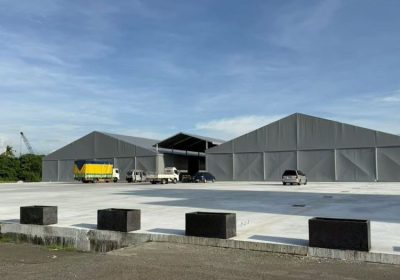
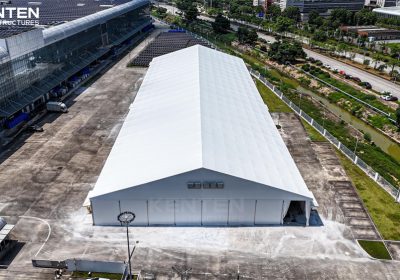
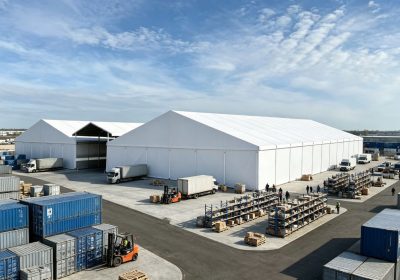
Aircraft Hangar Tent (also called an aircraft hangar tent or aviation shelter tent) is a modular aluminum-and-PVC structure designed for housing aircraft, helicopters, and aviation equipment — either temporarily or permanently. Compared to traditional brick-and-concrete hangars, they go up fast, cost significantly less, and can be relocated when your operation moves. That combination has made them the first choice for an increasing number of aviation operators, military units, and private aircraft owners.
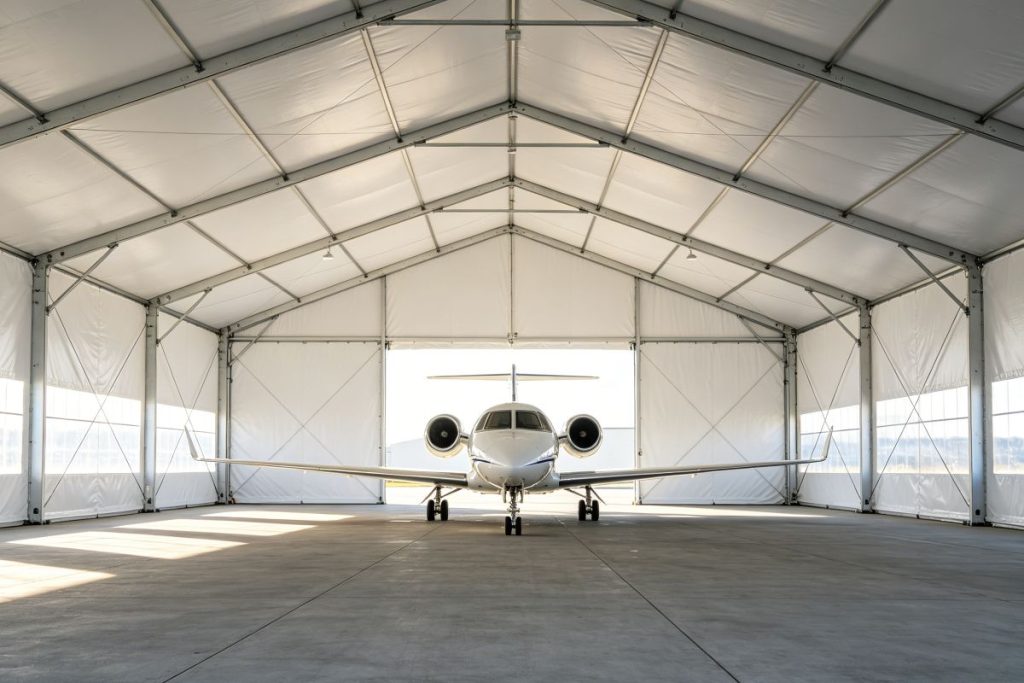
What Exactly Is a Hangar Tent?
A hangar tent is a clear-span aluminum structure — meaning no interior columns blocking your floor space. Widths range from 10m to 60m+, with unlimited length configurable to your fleet. KENTEN supplies fully customized dimensions based on your aircraft type and future expansion plans.
The core construction:
- Aluminum alloy frame: 6061-T6 aerospace-grade alloy — lightweight but extremely strong, naturally corrosion-resistant
- PVC tarpaulin cover: double-sided PVC-coated polyester, fire-rated to B1/M2 standards, waterproof and UV-resistant
- Bolt-together assembly: all components connect with bolts, enabling repeated assembly and disassembly without material degradation
- Flexible anchoring: ground anchor systems work on grass, gravel, concrete, or uneven terrain, ground screws, and base plates all available depending on site conditions
One general aviation operator shared their experience on an industry forum: they spent 14 months and over $800,000 USD building a traditional 8,600 sq ft (800m²) concrete hangar. Switching to a tent structure got them operational in 45 days, at less than half the total cost.
Common Applications for Hangar Tents
1. Private Aircraft and Business Jet Storage
Owning a hangar tent on your own apron gives you a perfect-fit solution: AC units can be installed to protect avionics from summer humidity, and heating systems can be added to ensure cold-weather engine starts.
2. Helicopter Maintenance and Parking
Helicopters have different spatial requirements than fixed-wing aircraft — rotor diameter, overall height, and maintenance access all factor in. Hangar tent clearance heights are fully customizable, and large roller doors or sliding gates can be cut into the sidewalls for easy aircraft movement. KENTEN supplied a 9m interior clearance hangar tent to a police aviation unit, fully accommodating AW139 helicopters for round-the-clock parking and routine maintenance.
3. Military Aviation Support
Military hangar requirements are predictable: fast deployment, portability, and readiness for field conditions. Hangar tents check every box — the entire structure packs into standard shipping containers, deploys in under 24 hours, and performs in demanding environments. KENTEN has delivered hardened, all-weather (waterproof, windproof, UV-protected) hangar tents to multiple military programs, with frame wind resistance rated to 120 km/h.
4. Drones and Emerging Aircraft
As eVTOLs and large UAVs proliferate, traditional hangars can’t meet this emerging market’s needs. Hangar tents offer the flexibility to create multiple smaller bays sized for individual aircraft, with charging infrastructure and monitoring system interfaces — at a fraction of the cost of purpose-built steel structures.
5. Airshow and Aviation Event Support
During airshows, flight demonstrations, and aviation competitions, temporary hangar demand spikes suddenly and disappears just as fast. Hangar tents are the natural fit for short-term rental. KENTEN has provided temporary hangar tents at multiple international airshows, with setup-to-handover taking as little as five days.
Hangar Tent vs. Traditional Hangar: Which Is Right for You?
The idea that “permanent is always better” trips up a lot of buyers. Here’s the real comparison:
Timeline: Traditional hangars take 12–24 months from permitting through construction. Hangar tents typically go from signed order to handover in 4–8 weeks. For operators who need facilities NOW, that gap can make or break a business launch.
Flexibility: Once a concrete hangar is built, its dimensions and layout are fixed. Hangar tents can be widened, lengthened, or moved to a new site entirely. KENTEN’s modular design means components from one project can be reused in the next.
One flight club operator from Xinjiang put it this way: “We have a dirt strip on our own property. Building a concrete hangar would have cost a fortune just in foundation work. Hangar tent anchors bolt straight into the ground, handles sandstorms without issue — we’ve been using ours for six years now.”
7 Key Specs to Evaluate Before Buying a Hangar Tent
1. Clear Span Width
This is the make-or-break spec. Standard sizes: 15m, 20m, 25m, 30m, 40m, 50m, 60m+. The wider the span, the more unobstructed your floor space — but the higher the per-square-meter cost. If you’re unsure, measure your aircraft at full wingspan, then add 1.5m of maintenance access on each side.
2. Wind Resistance
Wind rating depends on frame engineering and anchoring. KENTEN standard models are rated to 100 km/h; reinforced versions go to 120 km/h. If your site is in a typhoon zone or high-altitude airport, demand the reinforced version and ask for wind tunnel test documentation.
3. Snow Load
Operators in northern regions or high-altitude fields need to account for snow. KENTEN’s arched and peaked roof profiles naturally shed snow. Standard snow load is 75 kg/m²; heavy-snow versions handle up to 150 kg/m².
4. Door Opening
Standard hangar doors need at least 7m wide × 5m tall (single door) or 14m wide × 6m tall (double door). Options include rolling shutters, sliding gates, and bifold doors — choose based on how often doors will be opened and whether automation is needed.
5. HVAC and Ventilation Provisions
Long-term aircraft storage demands controlled temperature and humidity. Confirm the frame comes with pre-punched ducting and drainage knockouts, and whether the cover has an insulating coating (white PVC lets in more light but less heat; dark PVC insulates better but requires interior lighting).
6. Foundation Requirements
Hangar tents need far less foundation work than concrete buildings. Grass, gravel, and hardstand surfaces all work. Soft ground may need gravel leveling or load-distribution plates. KENTEN provides free on-site assessments.
How to Size Your Hangar Tent
Step 1: Lock in your aircraft
List the types and quantities you need to house, plus a 3–5 year growth projection.
Step 2: Calculate floor area
- Single Cessna 172 (~8m × 11m): minimum 15m × 20m = 300m²
- Single Bell 429 helicopter (~12m × 16m): minimum 20m × 25m = 500m²
- Single Gulfstream G650 (~21m × 26m): minimum 30m × 35m = 1,050m²
- Parking two aircraft side-by-side saves 30–40% versus two separate hangars.
Step 3: Add operational space
Reserve at least 1.5m for maintenance walkways, 20–30m² per aircraft for equipment storage, and dedicated zones for fueling or ground support if needed.
Step 4: Talk to KENTEN
KENTEN engineers will customize clearance height, door placement, sidewall openings, and more. Submit your aircraft specs and you’ll receive a preliminary layout and quote within 48 hours.
Bottom Line
Hangar tents are an underrated solution. For operators who need to get operational fast, control upfront capital, or maintain the ability to relocate facilities, they’re often the most practical answer available.
When evaluating options, focus on these five specs: clear span width, wind rating, snow load, door dimensions, and supplier credentials. If you’re in the comparison phase, KENTEN offers free on-site assessments and delivers preliminary proposals within 48 hours of confirmed requirements.