
Industrial Tent: Heavy-Duty Solutions for Storage, Worksites & Business Operations
When seasonal inventory piles up or your construction project needs a climate-protected workspace right now, industrial tent solutions bridge the gap between demand and permanent infrastructure. Companies across 80+ countries — from F1 racing teams to emergency relief organizations — rely on industrial tents when conventional buildings can’t be built fast enough or cost enough to make sense.
An industrial tent isn’t a party tent with bigger dimensions. It’s a heavy-duty shelter built to withstand demanding environments: high winds, heavy snow loads, and year-round exposure. Whether you need a temporary warehouse, a worksite enclosure, or a protected area for expensive equipment, the right industrial tent delivers robust performance without the commitment of a permanent structure.
This guide walks through everything you need to know before buying or renting an industrial tent — from key specifications to real-world applications and how to choose a manufacturer that will not leave you exposed when weather turns bad.
What Exactly Is an Industrial Tent?
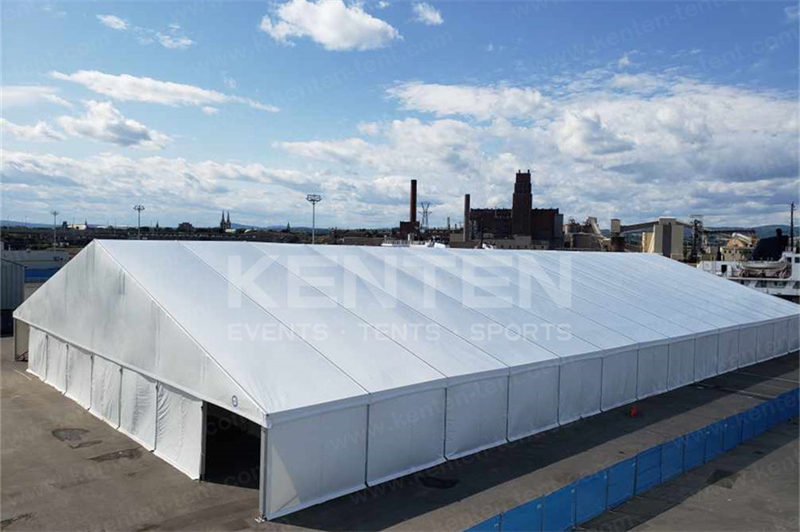
An industrial tent is a heavy-duty temporary or semi-permanent shelter for commercial, construction, and operational use — not casual events. The key differences from standard tents:
– Aircraft-grade aluminum — engineered for loads and wind resistance that would buckle lesser structures
– Clear-span interiors — no interior columns blocking your floor plan, so forklifts, cranes, and large equipment move freely
– Thick PVC or fabric covers — typically 650–950g/m², UV-stabilized, fire-rated to standards like EN 13501-1 or NFPA 701
– Modular wall systems — solid panels, transparent sections, insulated walls, or hard panels for security and climate control
– Professional anchoring — systems rated for asphalt, concrete, grass, and uneven terrain
Industrial tents serve two broad markets: operational (warehouses, manufacturing, logistics) and emergency/humanitarian (disaster relief, temporary housing, medical triage).
Common Applications for Industrial Tents
Warehouse & Storage Operations
The most frequent use for industrial tents is seasonal or peak-demand storage that permanent warehouses cannot accommodate. E-commerce operations during holiday peaks, agricultural storage for seasonal harvests, and logistics companies overflow — all drive demand for industrial tents.
Reddit discussions on r/smallbusiness and r/logistics consistently highlight a common pain point: “I need warehouse space for 3-4 months but signing a 5-year lease makes no sense.” Industrial tents solve exactly this problem — you get the space when you need it and can dismantle or relocate when you don’t.
Best for:
– Seasonal inventory overflow
– Agricultural equipment and feed storage
– Bulk materials storage
– Distribution center extensions
Construction & Worksite Enclosures
Construction companies use industrial tents to create climate-controlled workspaces on site — covering concrete curing areas, creating material staging zones, or providing sheltered workspaces during bad weather.
Key advantage over traditional site huts: an industrial tent covers a much larger area at a fraction of the cost of a portable building, and can be relocated as the project progresses.
Best for:
– Materials staging and storage
– Protected work areas during winter construction
– Site offices and break areas
– Equipment protection from theft and weather
Equipment & Vehicle Protection
Exposed equipment degrades faster. Industrial tents provide protected storage for expensive machinery, vehicles, and specialty equipment that needs to stay dry, shaded, or climate-controlled.
Farmers protecting tractors and combines, mining companies storing parts, event companies storing premium infrastructure — all rely on industrial tent covers to extend equipment lifespan and reduce maintenance costs.
Best for:
– Agricultural machinery storage
– Fleet vehicle protection
– Mining and industrial equipment covers
– Marine and aviation equipment storage
Emergency & Humanitarian Response
When disasters strike, industrial tents become critical infrastructure — serving as command centers, medical triage units, temporary housing, and supply distribution points.
KENTEN has supplied industrial tents for the Beijing Winter Olympics, Hangzhou Asian Games, and disaster relief operations globally. These applications demand fast deployment, reliable weather resistance, and modular expandability — qualities that define premium industrial tent design.
Best for:
– Disaster relief base camps
– Medical and triage structures
– Temporary housing for displaced populations
– Emergency command centers
Get to know industrial tent warehouses in one video.
How Industrial Tents Compare to Alternatives
Industrial Tent vs. Permanent Warehouse Building
The choice depends on duration, budget, and flexibility requirements:
Upfront cost: Industrial tents run 30–60% lower than full permanent construction
Setup time: Days to weeks for tents vs. months to years for buildings
Flexibility: Tents are relocatable and expandable; buildings are fixed
Maintenance: Low for tents (fabric replacement over years) vs. ongoing building upkeep
Best for: Short-to-medium term (months–years) vs. long-term (5+ years)
Permitting: Generally simpler for tents; full building permits typically required for structures
Reddit users frequently point out the permitting advantage: “I put up a 40×60 industrial tent on my lot without any building permits. A warehouse would have required months of approvals.” (r/construction). However, regulations vary significantly by location — always check local requirements.
Industrial Tent vs. Pole Barn or Metal Building
Pole barns and metal buildings cost more than industrial tents but provide greater permanence and weather resistance for **very long-term installations**. For operations requiring a facility for 10+ years with minimal planned relocation, a permanent structure may make better financial sense despite the higher initial investment.
For operations that value flexibility, tax treatment, and the option to relocate — industrial tents remain the smarter choice.
This is an application of our industrial tent warehouse in Taiwan.

Key Features to Evaluate in an Industrial Tent
Not all industrial tents are created equal. Here’s what separates premium industrial tents from budget alternatives that fail when you need them most:
Frame Engineering
Minimum standard: Hot-dip galvanized steel or basic aluminum
Premium standard: Aircraft-grade 6061-T6 aluminum with anodized finish, or powder-coated steel for corrosion resistance
Frame tube diameter and wall thickness matter more than material alone. Larger diameter, thicker-walled tubes resist buckling under snow loads and provide more secure anchoring points.
Fabric Quality
Minimum standard: 650g/m² PVC, self-extinguishing
Premium standard: 850–950g/m² multi-layer laminated PVC, UV-stabilized, fire-rated to EN 13501-1 or NFPA 701, 10+ year service life
UV stabilizers prevent the fabric from becoming brittle and cracking after years of sun exposure. Budget tents often skip this treatment — you will see the difference within 2-3 years of outdoor use.
Wind & Snow Ratings
This is where premium industrial tents genuinely outperform budget alternatives:
– Budget tents handle 60–80 km/h wind resistance with proper anchoring
– Premium industrial tents are certified for 100–120 km/h wind resistance
– Cold-climate models add snow load ratings of 75–150 kg/m²
Always ask for certified engineering ratings — not just marketing claims. Real wind and snow ratings come with structural calculations, not just assertions.
Clearspan Width
Industrial tents offer clearspan widths from 3m compact units to 60m+ mega-spans with no interior columns:
– Small (3–10m): Equipment storage, small workspaces
– Medium (10–25m): Standard warehouse applications, worksite covers
– Large (25–40m): Major logistics yards, large equipment storage
– Mega-span (40–60m+): Aviation hangars, major event venues, humanitarian base camps
How to Choose the Right Industrial Tent
Selecting an industrial tent involves five key decisions:
1. Define Your Primary Application
Warehouse storage, construction enclosure, equipment protection, and emergency response have overlapping but distinct requirements. Heavy equipment storage may require higher eave heights and stronger floor loading capacity. Emergency medical tents need rapid deployment and climate control compatibility.
2. Match Size to Your Actual Need
Common sizing mistakes:
– Too small: Leaving no room for growth or operational flexibility
– Too large: Paying for capacity you don’t use and facing unnecessary anchoring challenges
Measure your equipment, vehicles, or workflow requirements with adequate margin. Consider future needs — modular industrial tents expand lengthwise; choosing the right width from the start is critical.
3. Assess Your Site Conditions
Site conditions determine anchoring requirements and structural specifications:
– Wind exposure: Open sites, hilltops, and coastal locations need higher wind ratings
– Snow loads: Cold-climate installations require certified snow load capacity
– Ground surface: Asphalt, concrete, grass, and dirt each require different anchoring systems
– Accessibility: Confirm delivery access for large frame components
4. Plan for Climate Control
Industrial tents without climate control can experience extreme temperature swings — sweltering in summer, near-freezing in winter. If temperature matters for your operation, plan for:
– Insulation options (hard wall panels with insulation, double-layer air-inflated roofs)
– HVAC integration points (industrial tents can accommodate heating and cooling systems)
– Ventilation for moisture control in agricultural storage applications
5. Decide: Buy or Rent?
For occasional or short-term needs (single project, seasonal overflow), renting an industrial tent makes financial sense. For ongoing operations or recurring needs, purchasing typically provides better long-term economics and configuration flexibility.
KENTEN offers both purchase and lease options — our team can model the economics for your specific situation.
KENTEN Industrial Tents — Built for Demanding Environments
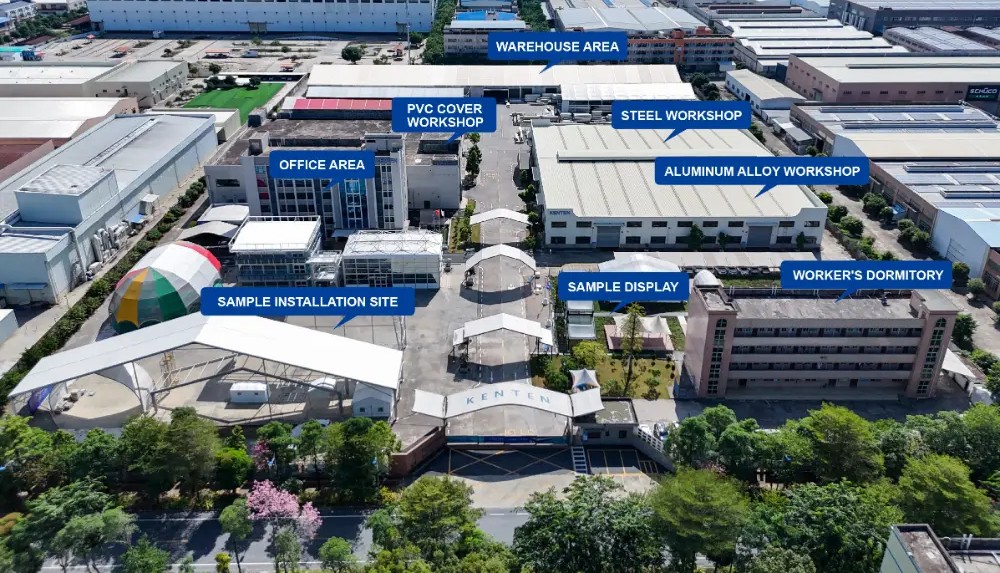
KENTEN has manufactured industrial tents for over 26 years, supplying solutions to companies and organizations across 80+ countries. Our manufacturing facility in Zhaoqing, Guangdong operates under ISO 9001/14001/45001 certifications, ensuring consistent quality across every tent we produce.
Why clients choose KENTEN for industrial tent solutions:
– Proven deployments: KENTEN industrial tents served the Beijing 2022 Winter Olympics, F1 Singapore and Miami Grand Prix events, Hangzhou Asian Games, and multiple disaster relief operations globally
– Certified engineering: Wind ratings up to 120 km/h, snow load ratings to 150 kg/m² — certified calculations available for specification submissions
– Custom configurations: Clearspan widths from 3m to 60m+, eave heights from 2.5m to 6m+, and full wall system options including insulated hard panels, transparent sections, and branded graphics
– Global logistics: We ship industrial tents worldwide with installation support available. Our team has experience navigating customs, permitting documentation, and local regulatory requirements across 80+ countries
– Responsive support: technical documentation, and consulting included with every purchase
Whether you need a single industrial tent for seasonal storage or a fleet of mega-span structures for a multi-year project, KENTEN delivers solutions engineered to perform when failure is not an option.
Conclusion
Industrial tents fill a critical gap between temporary inadequacy and permanent over-commitment. They deliver the protected, weather-resistant, flexible space that operations need without the cost, timeline, and inflexibility of permanent construction.
The difference between a quality industrial tent and a budget alternative becomes apparent the first time bad weather hits. Frames buckle. Covers tear. Anchoring fails. Premium industrial tents from manufacturers like KENTEN are engineered specifically to avoid these failure modes — with certified wind and snow ratings, UV-stabilized fabrics, and manufacturing quality you can verify before purchase.
Ready to explore your industrial tent options?
Get a Free Custom Quote → Contact KENTEN with your dimensions, application, and site conditions — our engineering team will specify the right configuration for your requirements.
Browse Industrial Tent Models → Warehouse Tent