Introduction: When Production Demand Moves Faster Than Infrastructure
In today’s manufacturing environment, demand rarely arrives on a predictable schedule. A new contract is secured. A major client increases orders. A supply chain shift creates unexpected opportunity. Or a competitor exits the market, opening a sudden gap. In each of these moments, the ability to scale production quickly becomes a decisive advantage. Yet for most manufacturers, capacity expansion remains tied to a slow and rigid system—one built around permanent construction, long approval cycles, and capital-intensive investment. What should be a moment of growth often turns into a bottleneck. The challenge is no longer whether demand exists. It is whether infrastructure can keep up.
Why Traditional Expansion Models Fail Under Time Pressure
Expanding production capacity through conventional factory construction has always been a long-term endeavor. It assumes stability: stable demand, stable supply chains, and stable planning horizons. That assumption no longer holds. Building a new facility typically involves multiple stages—site selection, permitting, engineering design, procurement, and construction. Even in efficient markets, this process can take months or even years. During that time, market conditions may shift, customer demand may fluctuate, and opportunities may disappear. What was once a strategic investment can quickly become a delayed response. At the same time, many manufacturers face internal constraints:
- Limited available land near existing facilities
- Disruption risks when expanding on-site
- High upfront capital requirements
- Difficulty forecasting long-term capacity needs
The result is a fundamental mismatch between how fast production needs to scale and how slowly infrastructure can be delivered.
Rethinking Capacity Expansion: From Fixed Assets to Flexible Systems
To expand production capacity quickly, manufacturers need to rethink not just how they build—but what they build. Instead of relying solely on permanent facilities, a growing number of companies are adopting a more flexible infrastructure strategy. The goal is not to replace traditional factories, but to complement them with systems that can be deployed rapidly and adapted over time. This shift is based on a simple principle: capacity should be scalable, not fixed. In practice, this means creating production environments that can be:
- Deployed within weeks, not years
- Expanded or reduced as demand changes
- Relocated when operational priorities shift
- Integrated with existing facilities
This approach transforms infrastructure from a constraint into a strategic tool.
Key Strategies to Expand Production Capacity Fast
There is no single solution that fits every scenario. However, the most effective manufacturers tend to combine several approaches, depending on urgency, budget, and operational requirements.
Optimize Existing Space Before Expanding
The fastest capacity gain often comes from within. Before investing in new infrastructure, manufacturers should evaluate how existing facilities are being used. Inefficiencies in layout, workflow, or storage can limit output more than physical space itself.
Common optimization opportunities include:
- Reconfiguring production lines for better flow
- Reducing bottlenecks in material handling
- Converting underutilized areas into active production zones
While this approach does not always deliver large-scale expansion, it can provide immediate relief and buy time for larger solutions.
Extend Production Hours and Shift Structures
Another short-term strategy is to increase output by extending operational hours.
This may involve:
- Adding additional shifts
- Running equipment for longer periods
- Adjusting workforce allocation
However, this approach comes with limitations. Labor availability, equipment wear, and energy costs can quickly reduce efficiency. It is best used as a temporary measure rather than a long-term solution.
Outsource or Diversify Production
In some cases, manufacturers can expand capacity by outsourcing part of their production to external partners or contract manufacturers.
This approach offers speed and flexibility, but introduces new challenges:
- Quality control risks
- Supply chain complexity
- Reduced operational visibility
For critical or high-value production, many companies prefer to retain control within their own facilities.
Deploy Modular Industrial Structures for Rapid Expansion
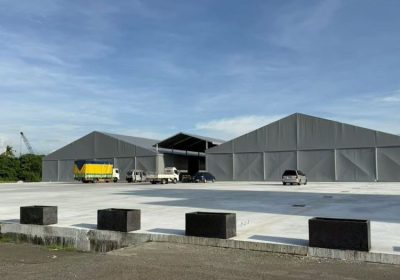
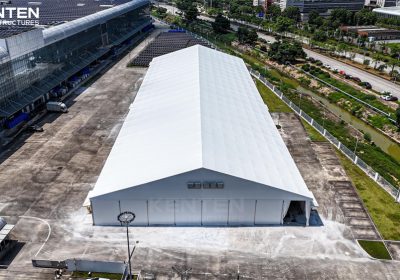
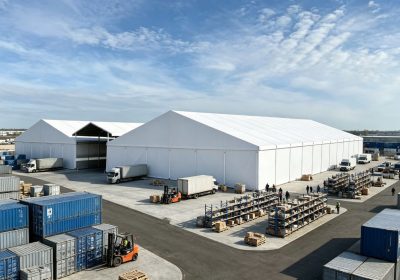
When additional physical space is required, speed becomes the defining factor. This is where modular industrial structures, like KENTEN A-structure Tents, offer a fundamentally different solution. Unlike traditional construction, modular structures can be deployed in a matter of weeks, providing fully functional production environments without long lead times. These structures are designed to support real industrial operations, not just storage. A well-engineered modular KENTEN A-structure Tent can deliver:
- Large-span, column-free interiors for flexible layouts
- High-clearance space for machinery and production lines
- Integration of ventilation, power, and access systems
- Adaptability for future expansion or relocation
This makes them particularly effective for:
- Rapid capacity expansion
- Interim production during facility upgrades
- Temporary or project-based manufacturing
- Emergency response scenarios
Rather than replacing permanent factories, KENTEN A-structure Tents act as a high-speed extension of production capability.
What Defines a “Production-Ready” Expansion Solution
Not all fast-built structures are suitable for manufacturing. Speed alone is not enough—performance matters. To function as a true production environment, an expansion solution must support the operational realities of industrial processes.
Key considerations include:
- Vertical space: Can the facility accommodate tall equipment or multi-level systems?
- Layout flexibility: Is the space column-free and adaptable to different workflows?
- Environmental control: Does it provide adequate ventilation and temperature management?
- Structural durability: Can it withstand continuous industrial use?
- Logistics integration: Are access points designed for efficient material flow?
Without these elements, a fast-built structure risks becoming a temporary workaround rather than a viable production asset.
The Strategic Advantage: Speed as a Competitive Edge
The ability to expand production quickly is no longer just an operational concern—it is a strategic differentiator. Manufacturers that can respond faster to demand gain multiple advantages:
- They capture market opportunities ahead of competitors
- They reduce lost revenue caused by capacity constraints
- They maintain stronger relationships with key clients
- They improve resilience in uncertain conditions
In this context, infrastructure becomes part of the competitive strategy.
Speed is not just about construction timelines—it is about how quickly a business can act.
Where KENTEN A-Structure Tents Fit In
KENTEN A-Structure Tents are designed specifically for scenarios where speed and performance must coexist. By combining modular deployment with industrial-grade engineering, they provide production-ready environments that can be delivered in weeks rather than years.

Key capabilities include:
- Up to 12-meter sidewall height for complex industrial setups
- Column-free spans enabling flexible production layouts
- Hard wall systems for durability and insulation
- Integrated ventilation and climate control solutions
- Electric roller shutter doors and logistics-ready access
These features allow manufacturers to deploy fully functional production space, not just temporary coverage. More importantly, the system remains adaptable—capable of scaling, reconfiguring, or relocating as production needs evolve.
Conclusion: Expanding Capacity Without Slowing Down
In a manufacturing landscape defined by speed and uncertainty, the ability to expand production capacity quickly is no longer optional—it is essential. Traditional construction will continue to play a role, particularly for long-term infrastructure. But it is no longer sufficient on its own. To remain competitive, manufacturers need solutions that match the pace of their operations—solutions that can be deployed rapidly, adapted continuously, and integrated seamlessly into existing systems. Expanding capacity is no longer just about building more space. It is about building smarter, faster, and with greater flexibility.
Contact KENTEN to explore a modular solution tailored to your operation, timeline, and scale.