Introduction: The Evolution of Temporary Event Architecture
In the past, temporary structures were designed with a single purpose: to provide shelter. Today, across Europe and North America, that expectation has fundamentally changed. Event organizers, developers, and brands are no longer looking for simple enclosures. They are searching for architectural spaces—structures that can shape atmosphere, enhance brand perception, and create memorable experiences. This shift has given rise to two important categories in the industry: atrium tents and orangery tents. But increasingly, a new hybrid solution is emerging—one that combines the strengths of both. This article explores the difference between these two concepts and introduces a new approach: KENTEN Curved Atrium Tent as a form of temporary architecture.

What Is an Atrium Tent?
An atrium tent is defined by its raised central roof structure, often referred to as a clerestory design. This architectural feature allows:
- Natural daylight to penetrate deep into the interior
- Warm air to rise and escape, improving ventilation
- A greater sense of vertical space and openness
Unlike traditional A-frame tents, atrium tents are designed with spatial performance in mind. They are commonly used in:
- Large-scale exhibitions
- Sports event venues
- Festivals and public gatherings
- Convention and summit environments
| Aspect | Atrium Tent | A-frame Tent |
| Architecture | High-end, iconic | Functional |
| Light | Natural & immersive | Limited |
| Experience | Engaging & premium | Basic |
| Flexibility | Highly customizable | Restricted |
| Brand Value | Strong visual identity | Minimal |
In essence, an atrium tent is not just a structure—it is a functional spatial system that enhances comfort, airflow, and usability.
What Is an Orangery Tent?
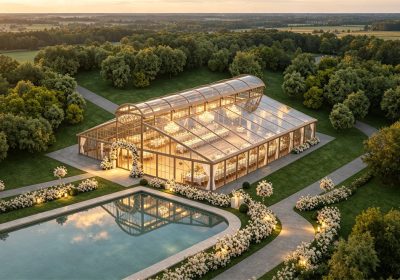
An orangery tent draws inspiration from classical European glasshouses. Historically, orangeries were elegant garden buildings used to cultivate citrus trees. Today, their architectural language has been reinterpreted into temporary structures. Featuring more on extensive use of glass or transparent panels ans strong visual emphasis on elegance and refinement, orangery tents are widely used in luxury weddings, gala dinners,VIP hospitality spaces, and boutique brand events. Orangery tents focus on aesthetic experience and are designed to create atmosphere, not just space.
Atrium Tent vs Orangery Tent: Key Differences
Although these two concepts are often confused, their design priorities are fundamentally different.
| Aspect | Atrium Tent | Orangery Tent |
| Core Function | Ventilation & spatial efficiency | Visual elegance & ambiance |
| Roof Design | Raised central roof | Flat roof |
| Experience | Open, breathable, functional | Intimate, refined, decorative |
| Typical Use | Large public events | Premium private events |
Understanding this distinction is critical when selecting the right structure for a project. However, modern event demands rarely fall into just one category.
The Rise of Hybrid Structures
Today’s event environments require both:
- Performance (capacity, airflow, adaptability)
- Aesthetics (visual identity, atmosphere, branding)
This has led to the development of hybrid structures that combine the best of both worlds.
One of the most advanced examples of this evolution is the curved atrium structure.
What Is a KENTEN Curved Atrium Tent?

KENTEN Curved Atrium Tent represents a new generation of modular event structure. It is both high-performing and visually striking with three key elements:
1. Atrium Roof Logic
A raised central roof improves:
- Natural lighting
- Passive ventilation
- Spatial hierarchy
2. Curved Geometry
The barrel-shaped roof introduces:
- A softer, more fluid architectural form
- Improved load distribution
- Strong visual identity
3. Orangery-Inspired Transparency
With glass or transparent facades, the structure achieves:
- Full visual openness
- Strong indoor-outdoor connection
- A refined, premium atmosphere
From Tent to Architecture
What sets KENTEN Curved Atrium Tents apart is their ability to move beyond the definition of a tent. They function as temporary architectural pavilions.
This means they can:
- Integrate into urban and natural environments
- Serve as visual landmarks
- Support complex event layouts and guest flow
In many cases, they are used not just for events, but for:
- Seasonal hospitality venues
- Pop-up restaurants
- Cultural installations
- Semi-permanent commercial spaces
This shift reflects a broader trend: temporary structures are becoming part of long-term spatial strategies.
Light, Transparency, and Experience
Modern event design is driven by experience. KENTEN Curved Atrium Tents are engineered to enhance this experience through light and transparency.
During the day:
- Natural light fills the interior
- The space feels open, calm, and connected to its surroundings
At night:
- The structure becomes a glowing architectural object
- Lighting design transforms it into a focal point
This dual identity makes it ideal for:
- Brand activities
- Festivals and cultural events
- VIP hospitality environments
Engineering Performance Behind the Design
Despite their architectural appearance, KENTEN Curved Atrium Tents are built on robust engineering systems.
- High-strength aluminum frameworks
- Modular components for scalable layouts
- Clear-span interiors with no internal columns
They are designed to meet international standards and safety regulations:
- Resistance to wind and snow loads
- Flame retardant material
- Efficient rainwater drainage
- Stability across diverse terrains
This ensures that KENTEN Curved Atrium Tent is not only visually impressive but also reliable in real-world conditions.
Flexibility and Modular Efficiency
One of the defining strengths of KENTEN Curved Atrium Tents is their modularity.
- Extended in length through repeated modules
- Customized in width and height
- Configured with different facade systems
Meanwhile, they deliver fully integrated environments:
- Lighting and rigging systems
- HVAC and flooring solutions
- Branding and decorative elements
This flexibility allows a single structure to adapt to multiple use cases—from intimate gatherings to large-scale public events.
Temporary by Definition, Long-Term by Value
Although classified as temporary structures, KENTEN Curved Atrium Tents designed for long-term use.
- Service life of up to20 years
- Reusability across multiple projects
- Faster approval compared to permanent buildings
For developers and event operators, this means:
- Lower upfront investment
- Faster deployment
- Greater operational flexibility
This makes them a practical solution for both short-term and recurring applications.
Applications Across Industries
KENTEN Curved Atrium Tents are now widely used across multiple sectors:
- Sports events & fan zones
- Festivals and seasonal celebrations
- Brand marketing & product launches
- Corporate events & experiential marketing
- Weddings & private celebrations
- Hospitality lounges & VIP areas
- Musical parties & entertainment spaces
- Temporary restaurants & pop-up dining venues
- Cultural ceremonies & public gatherings
Their ability to combine scale, flexibility, and atmosphere makes them suitable for both public and premium environments.
Conclusion: A New Category of Event Space
The distinction between atrium tents and orangery tents reflects a broader evolution in the industry. Today, the most effective structures are not limited to one category.
KENTEN Curved Atrium Tent represent this new category with combination of:
Performance of atrium systems
Elegance of orangery design
Flexibility of modular construction
They are not simply temporary tent. They are architectural spaces designed for experience, adaptability, and impact.
Contact KENTEN to discover how a curved atrium structure can transform your project into a landmark space.