Introduction: Rethinking Sports Architecture in an Unpredictable Climate
For decades, sports facilities have been designed around an implicit assumption: weather dictates usage. Outdoor fields shut down due to bad or harsh weather conditions. Temporary tents extend the season slightly. Permanent gymnasiums require years of construction and significant capital investment. However, climate volatility, land constraints, and evolving training models are challenging this logic. Schools, academies, and sports operators are no longer asking how to build bigger facilities—they are asking how to use space more intelligently, more consistently, and more sustainably. Modular structure, take KENTEN A-frame Structures for example, has emerged as a compelling alternative. When equipped with thermal-proof roof and insulated facades with integrated HVAC systems, the A-frame tent becomes a true all-season sports building, capable of supporting continuous training cycles regardless of external conditions.

From Weather-Dependent to Program-Driven Sports Spaces
Traditional sports infrastructure, which is open to surroundings, is reactive: activities pause when conditions deteriorate. This creates fragmented training schedules, underutilized assets, and lost instructional time. An enclosed KENTEN A-frame Structure reverses this relationship. Instead of adapting sport activities to weather, the environment is engineered to support these sports. With proper insulation and climate control, interior conditions remain stable year-round. This allows operators to plan training calendars with confidence:
- Technical training continues through winter without interruption
- Conditioning programs shift seamlessly between seasons
- Competitions and evaluations follow consistent timelines
Sports facilities become program-driven, not weather-driven—a fundamental shift in how space is valued and managed.
Architectural Simplicity, Structural Intelligence
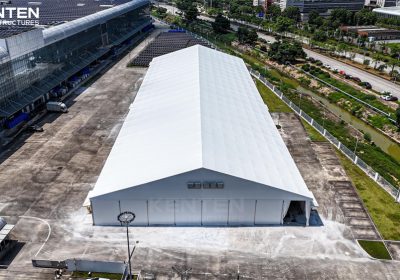
The strength of the A-frame tent lies in its clarity. Structurally, the inclined geometry efficiently transfers loads, making it well-suited for large-span enclosures. Architecturally, the form is simple, recognizable, and adaptable. When executed as a modular aluminum system, KENTEN A-frame Structures offer:
- Large, column-free interior spans
- Clear spatial organization for courts and training zones
- Easy integration of lighting, ventilation, and services
This combination of simplicity and performance makes the A-frame tents ideal for sports applications, where unobstructed space and operational reliability are paramount.
Insulated Envelopes: The Key to All-Season Performance
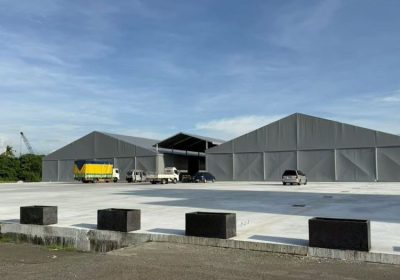
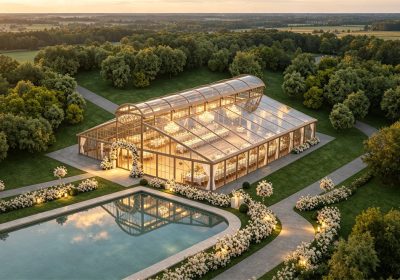
The transition from a seasonal tent to an all-season facility depends largely on the building enclosure. Modern KENTEN A-frame Structures can be enclosed with temperature-protected roof and insulated glass panels, solid sandwich wall systems, or hybrid facades combining insulation and transparency. These systems dramatically reduce heat exchange with the exterior, improving both comfort and energy efficiency. In winter, heat loss is minimized. In summer, solar radiation is controlled. In the rest seasons of a year, both rain and wind are blocked. The result is a stable interior environment that supports consistent athletic performance. KENTEN A-frame Structure transforms the ordinary A-frame tent from a tent-like solution into a high-performance modular building.

HVAC as an Enabler of Training Continuity
In sports environments, temperature and air quality directly affect performance, safety, and recovery. Integrated HVAC systems allow KENTEN A-frame Structures to maintain precise control over:
- Temperature ranges suitable for different sports
- Air circulation and freshness during intensive activity
- Humidity levels that protect flooring and equipment
This enables a unique and proven operational advantage: winter training programs can be conducted in summer-like conditions, and summer preparation can continue through winter months. Athletes train consistently. Coaches plan long-term. Facilities operate at full capacity year-round.
Multi-Sport, Multi-Use by Design
KENTEN A-frame Structures are inherently flexible. With no internal columns and a regular structural grid, the interior can be configured for a wide range of activities.
Typical applications include:
- Basketball and volleyball courts
- Badminton and tennis centers
- Soccer(Football) or Rugby(American Football) fields
- Padel and pickleball training
- Ice-hockey and ice-skating ranks
- Swimming pools
- Fitness training and physical education classes
- Multi-purpose community sports events
Over time, layouts can be adjusted, markings changed, and equipment updated—without altering the core structure. This adaptability ensures the facility remains relevant as programs evolve.
Faster Delivery, Lower Disruption
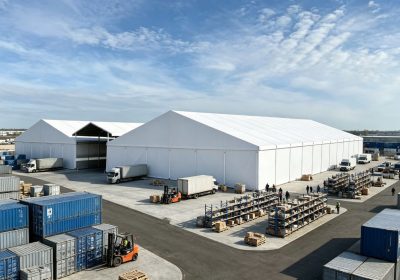
Compared to conventional sports halls, KENTEN A-frame Structures offer a significant advantage in delivery speed. Prefabricated structural components are manufactured with CNC machines and assembled rapidly on location. Foundations are minimal: they are suitable for any terrains. Construction schedules and costs are predictable.With proper art design on the facades, the tent could even become a landmark, instead of being a site disruption. For schools and institutions, this means facilities can be installed during academic breaks and operational by the next term—avoiding prolonged disruption to daily activities. Speed, in this case, is not a compromise. It is a strategic advantage.
Long-Term Value Beyond “Temporary” Thinking
While often categorized as temporary structures, well-designed A-frame sports tents challenge this assumption. With durable aluminum frames, replaceable enclosure systems, and modular components, these structures are designed for long-term use, relocation, or expansion. KENTEN A-frame Structures can adapt to scaling enrollment, new sports activities, or different sites over time. From an asset perspective, this flexibility reduces risk and extends value—especially in environments where land use and program requirements continue to evolve.
- High-strength 6061/T6 aluminum alloy framework
- Modular bay lengths enabling scalable layouts
- Compatibility with PVC covers, glass facades, or solid wall systems
- Customization with upto 12m for the eave height
- Integration of suspended systems
- Rapid installation and dismantling schedules
- Structural calculations tailored to regional snow and wind loads
- Designed with European and America regulation codes
Sustainability Through Reuse and Efficiency
Sustainability is no longer defined solely by materials, but by life cycle performance. KENTEN A-frame Structures contribute to sustainable development by:
- Reducing construction waste through prefabrication
- Minimizing permanent land alteration
- Supporting energy-efficient operation
- Enabling reuse across multiple projects and seasons
- Interchangeable components for easy maintenance
By maximizing utilization and minimizing redundancy, these tent represent a responsible approach to modern sports infrastructure.
Conclusion: Building Sports Facilities That Work All Years
As sports programs demand greater continuity, flexibility, and efficiency, infrastructure should evolve accordingly. KENTEN A-frame Structure—when equipped with insulated facades and integrated HVAC systems—offers a powerful response. It delivers the spatial quality of a permanent building, the speed of modular construction, and the adaptability required for year-round operation. In a world where seasons are becoming less predictable, the smarter sports tents are those designed to perform across all seasons.
Contact KENTEN to discuss a customized weather-resilient tent for your sports.