Why the KENTEN Pyramid Structure Is More Than a Shape
In the Middle East, architecture is never neutral. Buildings are expected to respond to climate, convey authority, support large-scale public life, and project a sense of permanence—even when they are technically temporary. This is precisely where KENTEN Pyramid Structures have found their relevance and momentum. Across the Gulf region and wider Middle East, pyramid structures or modular tents have become a preferred solution for exhibitions, sports venues, government facilities, hospitality complexes, and large-scale public events. Their success is not coincidental. It is the result of a rare alignment between environmental demands, cultural expectations, and operational realities. KENTNE Pyramid Structure is not positioned as a tent in the conventional sense. It is conceived as a modular architectural system—engineered to perform under extreme conditions, while delivering the visual authority and functional clarity required by Middle Eastern clients.

What Is a KENTEN Pyramid Structure?
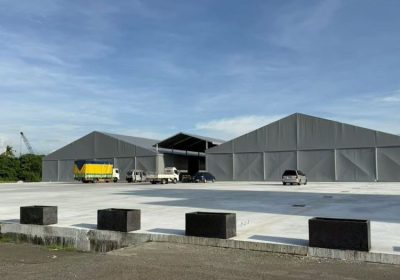
KENTEN Pyramid Structure—also referred to as a Revolution Structure, Smart Structure, or Manhattan Structure—is a modular architectural system built around a three-dimensional aluminum space-frame roof. The roof is formed by standardized pyramidal units interconnected at engineered nodes, creating a rigid, self-stabilizing structural grid with excellent load distribution and spatial efficiency.
- 6061/T6 high-strength aluminum alloy framework
- Space frame roof system with multi-directional load paths
- Large clear-span interiors with no internal columns
- Modular bay widths and lengths for scalable layouts
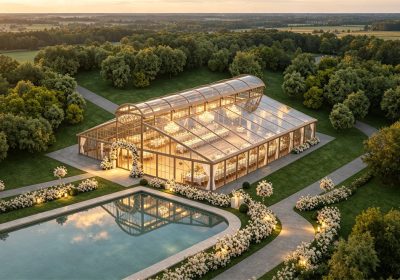
- Compatibility with PVC membrane, sandwich panels, or full glass facades
- Suitable for temporary, semi-permanent, and long-term installations
This structural logic has been widely adopted in large-scale commercial, civic, and public-use environments, including transport hubs, exhibition halls, sports facilities, pavilions, and multifunctional venues. When realized as a modular aluminum system, KENTEN Pyramid Structure delivers architectural-scale performance while dramatically shortening construction and deployment timelines.
Extreme Climate as a Design Driver
Few regions place higher demands on structures than the Middle East. High temperatures, intense solar radiation, sudden sandstorms, and seasonal wind loads all shape how buildings should perform. The pyramid geometry responds naturally to these conditions. Its inclined roof planes reduce direct solar exposure during peak hours while enabling efficient heat dissipation. Wind loads are distributed evenly through the sloped surfaces, minimizing uplift risks that challenge lat or low-pitch roof systems. Rainwater, although infrequent, is efficiently drained without structural stress. Regional demand often emphasize climate resilience, rapid deployment, and operational reliability in their communications. The underlying message is clear: in this market, structures need to satisfy efficiency, flexibility, and relocatability, as well as maintaining spatial performance, aesthetics are even considered.
KENTEN Pyramid Structures integrate these same principles through engineered aluminum frameworks, high-performance membrane systems, and adaptable insulation options—allowing the structure to function as a comfortable interior environment even when exterior conditions are harsh and unpredictable.
Scale, Span, and the Logic of Open Space
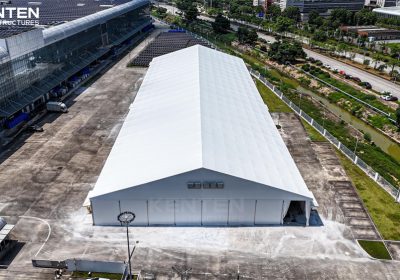
Middle Eastern events and facilities operate at a scale that few other regions match. Large congregations, formal ceremonies, exhibitions, and hospitality programs demand expansive, uninterrupted interior spaces. KENTEN Pyramid Structure excels in this context. Its structural logic enables long clear spans with minimal internal columns, allowing planners to maintain views, circulation efficiency, and spatial hierarchy. Whether configured as a monumental hall or as a series of buildings, the system is scalable and transformable without compromising structural clarity or disrupting current operation. This is one reason why KENTEN frequently frame modular structures as “venue solutions” rather than temporary tent. The expectation is not short-term coverage, but operational space that performs like permanent architecture.
Modular concept is treated as an asset strategy. KENTEN Pyramid Structure can be expanded, reconfigured, or relocated as program needs evolve—making them particularly suitable for governments, developers, and operators planning multi-phase or multi-year usage.
From Temporary Use to Long-Term Asset
Perhaps the most important reason KENTEN Pyramid Structures thrive in the Middle East is a shift in how “temporary” is defined. Increasingly, clients view modular structures as long-term assets—deployed for extended periods, relocated across sites, or repurposed across functions. This aligns closely with sustainability objectives. Reusable structural systems reduce material waste, limit site disruption, and offer a lower life cycle footprint compared to permanent construction for short- to mid-term needs. KENTEN Pyramid Structures are engineered with this life cycle perspective in mind. Components are designed for repeated assembly, structural integrity over time, and compatibility with future upgrades—transforming what was once considered temporary into a strategic investment.

Typical Applications in the Middle East Market:
KENTEN Pyramid Structures are conceived beyond the conventional definition of a “temporary tent.” They function as high-performance modular buildings that combine long clear spans, verified structural reliability, and adaptable facade systems to achieve both engineering credibility and architectural presence.
- Supermarkets
- Educational institutes
- Exhibition centers
- Transportation terminals
- Sports stadiums
- Brand showrooms
- Executive offices
- Museums
- Concert halls
- Hospitality venues
- Restaurants
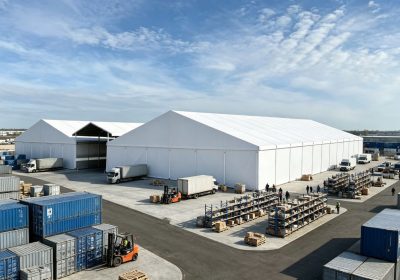
- Warehouses & storage
- Logistics & distributions
- Production centers
- Hangars
- Cultural ceremonies
Designed for rapid deployment without compromising spatial quality, KENTEN Pyramid Structures enable fast activation of land assets while supporting efficient layouts, scalable expansion, and predictable construction costs. Their modular logic and durable aluminum systems make them suitable for long-term use across urban, suburban, and remote environments—offering a sustainable alternative to traditional permanent construction.
Conclusion: A Structure That Fits the Region’s Ambition
The success of KENTEN Pyramid Structures in the Middle East is not driven by trend, but by alignment. Climate realities, cultural expectations, scale requirements, and time pressures converge to favor a system that is robust, expressive, and adaptable. KENTEN Pyramid Structure represents a clear direction: modular architecture that respects regional context while enabling future flexibility. It is not about replacing permanent buildings, but about offering a smarter alternative when speed, scale, and adaptability matter most. In a region defined by ambition and pace, KENTEN Pyramid Structures do more than stand—they perform, represent, and endure.
Contact KENTEN to discuss a customized pyramid structure solution for your project.