Introduction
Warehouse tents and permanent warehouses represent two widely adopted solutions for industrial storage, logistics, and manufacturing facilities. As businesses face increasing pressures to expand rapidly, control costs, and maintain flexibility, selecting the appropriate storage structure is no longer merely a construction decision—it is a critical strategic choice.
Warehouse tents utilize modular aluminum alloy structures, offering rapid installation and flexible utilization; whereas permanent warehouses are fixed concrete structures designed for long-term operations. Both solutions present distinct advantages regarding project timelines, budgets, site selection, and regulatory compliance.
This guide compares warehouse tents and permanent warehouses across five dimensions—cost, construction speed, durability, flexibility, and practical applications—to help you identify the solution best aligned with your business needs.
What is a Warehouse Tent?
A warehouse tent is a column-free aluminum structure covered with PVC fabric or insulated wall systems. Unlike traditional buildings, warehouse tents feature a modular design that requires no heavy foundations for installation.

Core Features:
- High-strength aluminum alloy frame (6061-T6, 6082-T6)
- Column-free, large-span interior space
- PVC/ABS or sandwich panel walls
- Temporary or semi-permanent applications
- Rapid installation and easy relocation
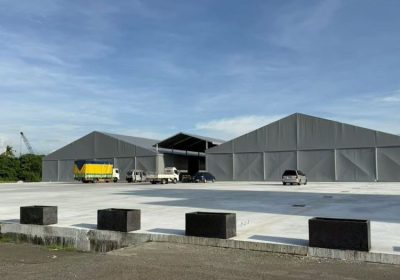
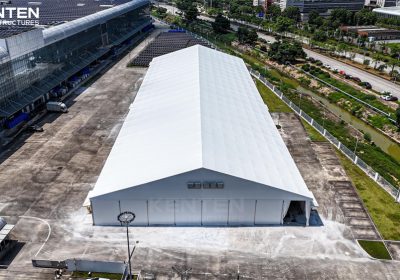
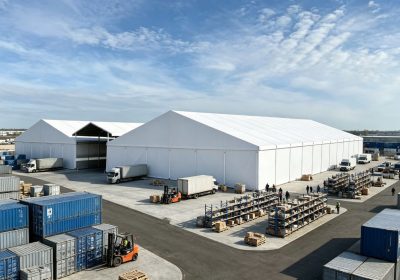
Warehouse tents are widely used for logistics warehousing, production expansion, building material storage, seasonal inventory, and emergency facilities.
What is a Permanent Warehouse?
A permanent warehouse is a fixed structure built using concrete, steel, or masonry. These facilities are designed for long-term use and typically require full compliance with local building codes and zoning regulations.
Key Characteristics:
- Reinforced concrete framework
- Permanent foundation
- Extended construction timeline
- Fixed layout and location
- Higher initial investment
Permanent warehouses are commonly used for long-term manufacturing facilities and centralized distribution centers.
Warehouse Tents vs. Permanent Warehouses: Key Differences
| Category | Warehouse Tents | Permanent Warehouses |
|---|---|---|
| Construction Period | 3–7 days | 6–12 months |
| Initial Cost | Low to moderate | High |
| Flexibility | Fully modular and relocatable | Fixed and immutable |
| Foundation Requirements | Minimal or none | Must be constructed |
| Service Life | 20–30 years (Frame) | 40–50+ years |
| Expansion Difficulty | Simple and Quick | Complex and Expensive |
| Approval Permits | Typically Streamlined | Often Involve Complex Processes |
Cost Comparison
Cost is one of the primary reasons businesses choose warehouse tents over permanent structures.
Cost Advantages of Warehouse Tents
- Initial investment reduced by 40–70%
- Eliminates need for heavy foundation work
- Reduces permitting and approval fees
- Lowers maintenance expenses
- Reusable and relocatable
Permanent Warehouse Cost Considerations
- High land development costs
- Engineering design and construction expenses
- Lengthy construction financing cycles
- Non-relocatable
For medium-to-short-term storage needs, warehouse tents offer a more cost-effective solution.
Construction Speed
Warehouse Tents
Warehouse tents can typically be installed within one week, depending on size and site conditions. This makes them an ideal solution for businesses facing urgent storage shortages.

Permanent Warehouses
Permanent warehouses usually require 6 to 12 months or longer, encompassing design, approvals, foundation work, and construction. Delays due to weather or regulatory approvals are common.
When speed is critical, warehouse tents offer a clear advantage.
Durability and Service Life
Modern aluminum warehouse tents are engineered for long-term use.
- Aluminum frame lifespan: 15–30 years
- PVC fabric lifespan: 8–15 years
- Designed to meet local wind and snow load standards
- Constructed with corrosion-resistant materials
While permanent warehouse structures offer extended longevity, most businesses find the durability of warehouse tents fully meets their operational cycle needs without the burden of permanent construction.
Flexibility and Relocatability
One of the greatest advantages of warehouse tents lies in their flexibility.
Warehouse Tents
- Fully relocatable
- Easily scalable up or down
- Suitable for temporary sites and leased land
Permanent Warehouses
- Fixed structure
- Difficult and costly to modify
- Not suitable for short-term or uncertain projects
For businesses, flexibility is a decisive factor.
Environmental Control and Insulation Performance
Warehouse tents can be equipped with:
- Insulated sandwich panel walls
- Double-layer PVC roofing
- Air conditioning and ventilation systems
- Flooring
With proper insulation design, warehouse tents can meet the temperature and humidity requirements for electronics, food, chemicals, and industrial goods, matching the performance of permanent warehouses.
Cases

When to Choose Warehouse Tents?
Warehouse tents are ideal when you require:
- Rapid deployment
- Reduced upfront costs
- Temporary or semi-permanent storage
- Relocatable or expandable space
- Seasonal or project-based facilities
Suitable industries include logistics, construction, manufacturing, mining, sports venues, and disaster relief.
When to Choose a Permanent Warehouse?
If you require:
- Long-term fixed operations
- Permanent land ownership
Conclusion
Both warehouse tents and permanent warehouses hold distinct value in modern industrial storage. However, for businesses prioritizing speed, cost-effectiveness, and flexibility, warehouse tents offer an ideal alternative to traditional construction.
Aluminum warehouse tents deliver reliable performance and extended lifespan, adapting flexibly to business growth—unconstrained by permanent structures.
KENTEN specializes in providing customized aluminum warehouse tent solutions for global industrial applications.
Frequently Asked Questions
Q1: How long does it take to install a warehouse tent?
A: Most warehouse tents can be installed within 7 days. Factors affecting installation time include size and weather conditions.
Q2: Does a warehouse tent require a foundation?
A: No heavy-duty foundation is needed. Concrete blocks, asphalt, ground anchors, or grass surfaces are sufficient.
Q3: Can warehouse tents be insulated?
A: Yes, insulated wall panels and inflatable roof options are available.
Q4: What is the lifespan of a warehouse tent?
A: Aluminum frames typically last 15-30 years with proper maintenance.
Q5: Are warehouse tents suitable for extreme climates?
A: Yes, they can be engineered to withstand local wind, snow loads, and temperature conditions.