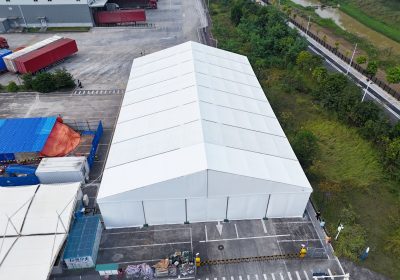
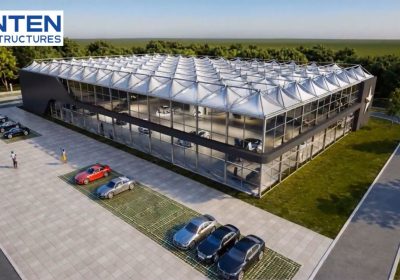
Aluminum Warehouse Tent Structures: The Fast, Flexible Storage Solution Modern Businesses Need
When peak season hits and your warehouse is at 110% capacity, the clock starts ticking. Every day of delayed shipments costs money, damages customer relationships, and creates chaos in your supply chain. But traditional warehouse construction? It takes months, costs millions, and requires permits, zoning approvals, and a permanent commitment to a location you might not even own.
That’s where aluminum warehouse tent structures come in.
These modular, high-performance storage canopies are transforming how businesses handle overflow inventory, seasonal surges, emergency storage needs, and even semi-permanent facility expansion. With aluminum frames that are 40–50% lighter than steel, industrial-grade PVC membranes that shrug off wind and rain, and installation timelines measured in days instead of months, aluminum warehouse tents are no longer a compromise—they’re a strategic advantage.
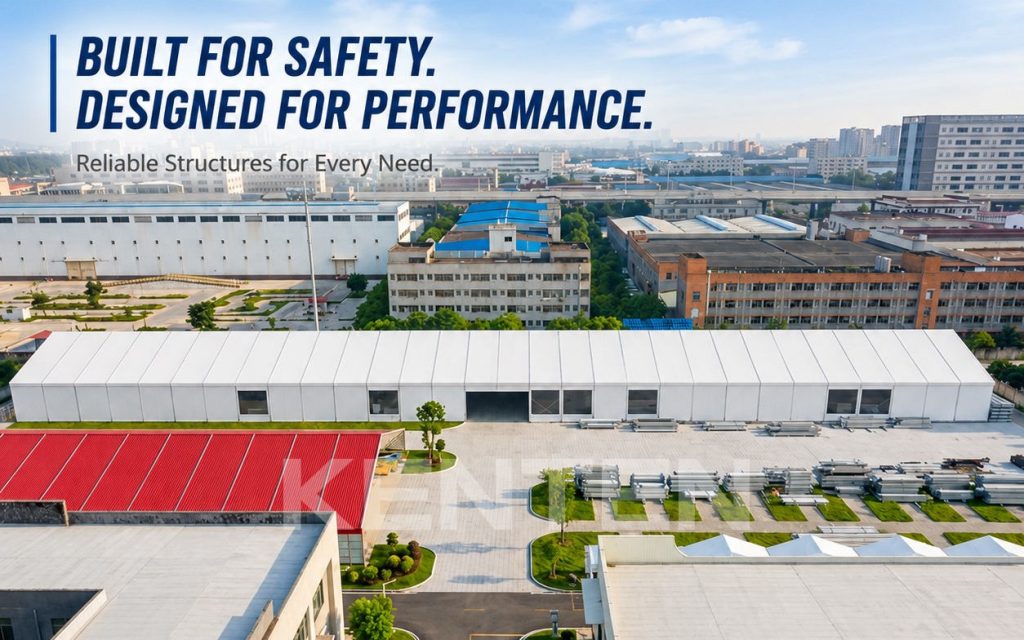
What Is an Aluminum Warehouse Tent Structure?
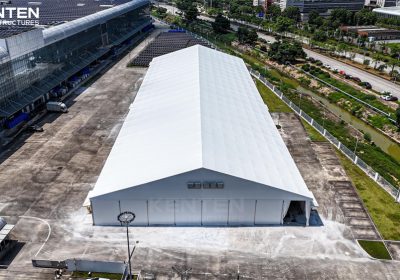
An aluminum warehouse tent (also called an industrial storage tent, fabric warehouse building, or warehouse canopy) is a semi-permanent or relocatable structure designed to provide large-span, weather-protected storage and operational space.
Unlike traditional brick-and-mortar warehouses, these structures use:
- Aluminum alloy frame (typically 6061-T6 or 6082-T6) — lightweight, corrosion-resistant, and engineered for structural integrity
- PVC-coated polyester membrane (750–1100 g/m²) — waterproof, UV-resistant, flame-retardant, and light-transmitting
- Modular connection systems — bolted/aluminum extrusion connections for fast assembly and disassembly
- Minimal foundation requirements — ground anchors, concrete slabs, or ballast plates depending on site conditions
The result is a clear-span interior with no interior columns, giving you the full usable floor area you need for racking, forklifts, loading docks, and high-cube storage.
Why Aluminum Frames? The Material Advantage Explained
You might wonder: why choose aluminum over steel for a warehouse structure? The answer comes down to three core properties:
1. Corrosion Resistance
Aluminum naturally forms a protective oxide layer that prevents rust, even in humid, coastal, or chemically exposed environments. Steel frames, by contrast, require hot-dip galvanizing or powder coating to achieve similar corrosion resistance—and those coatings can degrade over time.
For businesses storing moisture-sensitive goods (paper, textiles, electronics, chemicals), or operating in coastal regions, aluminum eliminates the single biggest long-term maintenance headache in warehouse infrastructure.
2. Superior Strength-to-Weight Ratio
Aluminum alloy achieves tensile strengths of 275–310 MPa (for 6061-T6) while weighing only ~2.7 g/cm³—roughly one-third the weight of steel. This means:
- Easier handling and faster erection
- Reduced foundation load requirements
- Lower transportation costs
- Ability to deploy on terrain where heavy steel structures couldn’t be anchored
3. Design Flexibility
Aluminum extrusions can be produced in virtually any cross-sectional profile, allowing custom-engineered frame geometries for specific wind loads, snow loads, or clearance requirements. This makes aluminum structures ideal for bespoke warehouse configurations—odd-shaped lots, height restrictions, multi-bay complexes, and more.
Top 8 Benefits of Aluminum Warehouse Tent Structures
1. Deploy in Days, Not Months
Traditional warehouse construction: 6–18 months minimum. Aluminum warehouse tent: 3–10 days for a typical single-bay structure (500–2,000 m²).
This speed-to-operational is perhaps the single biggest driver of adoption. A business facing a sudden inventory surge can have a fully operational storage tent up and running before a conventional building permit would even be approved.
2. Dramatically Lower Cost
| Structure Type | Cost per m² (Approx.) | Lead Time | Lifespan |
|---|---|---|---|
| Traditional warehouse (steel/concrete) | $400–$800+ | 6–18 months | 50+ years |
| Steel container/industrial building | $150–$300 | 3–6 months | 30–50 years |
| Aluminum warehouse tent | $35–$120 | 3–10 days | 15–25 years |
Aluminum tent structures deliver 60–80% cost savings over conventional warehouse construction—without the long-term debt or capital commitment.
3. 100% Clear-Span Interior
Clear spans of 10m to 60m with no interior columns mean:
- Unrestricted forklift and truck movement
- Full utilization of racking systems
- Open floor plans for sorting, staging, and cross-docking
- Easy installation of conveyor systems and automated storage/retrieval systems (AS/RS)
4. Fully Relocatable
If you lease your site, are managing a temporary operations surge, or simply want to test a location before committing to permanent infrastructure, aluminum warehouse tents can be disassembled, transported, and reassembled at a new site. This flexibility is virtually impossible with conventional buildings.
5. No Permanent Foundation Required
Aluminum warehouse tents typically require only:
- Ground anchors (for soft surfaces like grass or gravel)
- Ballast plates (for surfaces that can’t be penetrated, like concrete or asphalt)
- Light concrete footings (for permanent installations)
This eliminates the cost and time of foundation engineering—saving $20,000–$100,000+ depending on site conditions.
6. All-Weather Protection
Modern PVC membranes (750–1100 g/m²) provide:
- Waterproofing: 100% watertight, even during torrential rain
- UV protection: Blocks 90%+ of harmful UV radiation, protecting light-sensitive goods
- Wind resistance: Engineered for 80–120 km/h (standard) up to 160 km/h (coastal/enhanced)
- Snow load capacity: 0.5–1.5 kN/m² depending on design
- Fire rating: B1/DIN 4102 or M2 certified (flame retardant)
7. Natural Daylight Inside
The translucent properties of PVC fabric allow 10–15% natural light transmission, reducing daytime electricity consumption for lighting. For operations that run during daylight hours, this can translate to meaningful energy savings—and a more pleasant working environment for staff.
8. Expandable on Demand
Need more storage next quarter? Add another bay. Aluminum warehouse tent systems are modular by design—you can extend length indefinitely by adding bay sections. This scalability makes it easy to right-size your storage footprint as your business grows or contracts seasonally.
Common Applications for Aluminum Warehouse Tents
Aluminum warehouse tent structures aren’t just for emergencies—they’re used across a wide range of industrial and commercial applications:
🔹 Peak Season & Overflow Storage
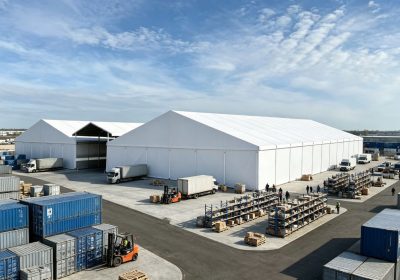
The most common use. E-commerce companies during Q4, agricultural businesses during harvest, retailers during promotional periods—all face massive, predictable spikes in inventory. An aluminum warehouse tent handles overflow without requiring a permanent investment.
🔹 Supply Chain Disruptions
When a key supplier delays, a logistics node fails, or demand forecasting misses the mark, temporary warehouse tents provide immediate breathing room.
🔹 Manufacturing Floor Expansion
Factory production lines at capacity? An aluminum tent adjacent to your facility creates instant parts staging, finished goods storage, or even auxiliary production space.
🔹 Logistics & Distribution Hubs
Third-party logistics (3PL) companies use aluminum warehouse tents to scale capacity rapidly when onboarding new clients or handling contract surges.
🔹 Equipment & Vehicle Storage
Construction companies, event producers, and agricultural operations use large-span warehouse tents to protect expensive equipment, machinery, and vehicles from weather damage.
🔹 Cold & Temperature-Sensitive Storage
With insulated double-layer membrane options and optional HVAC integration, aluminum warehouse tents can serve as temperature-controlled storage for pharmaceuticals, food products, and chemicals.
🔹 Emergency & Disaster Relief
Government agencies and NGOs use rapid-deploy aluminum tent warehouses for disaster response—storing relief supplies, shelter materials, and medical equipment in crisis zones.
Key Specifications: What to Look For
| Specification | Standard Range | Notes |
|---|---|---|
| Frame Material | Aluminum alloy 6061-T6 / 6082-T6 | Check certification and alloy grade |
| Clear Span Width | 10–60m | Customization supported |
| Bay Spacing | 3–5m | Customization supported |
| Eave Height | 4–10m | Customization supported |
| Ridge Height | 6–12m | Customization supported |
| Wind Load Rating | 80–160 km/h | Verify against local building codes |
| Snow Load | 0.5–1.5 kN/m² | Critical for cold-climate installations |
| Cover Membrane | PVC 750–1100 g/m² | UV-stabilized, flame-retardant |
| Fire Rating | DIN 4102 B1 / M2 | Required for most industrial applications |
| Light Transmission | 8–15% | Translucent for natural daylight |
| Waterproof Rating | 100% | Welded seam construction |
| Frame Lifespan | 15–25 years | Aluminum frame only |
| Membrane Lifespan | 8–15 years | PVC cover replacement |
| Installation Time | 3–10 days (per bay) | Professional crew required |
Installation Process: Step by Step
Week 1: Site Assessment & Engineering
- Ground survey and soil assessment
- Wind/snow load analysis for local conditions
- Engineering drawings and structural calculations
- Permit application support (if required)
Week 1–2: Foundation Preparation
- Ground anchors installation or concrete pad pouring
- Drainage planning and ground leveling
- Electrical conduit routing (if applicable)
Days 3–7: Frame Assembly
- Aluminum columns and truss erection
- Bolted/aluminum extrusion connections
- Quality inspection at each stage
Days 7–10: Membrane Installation
- PVC cover unfolding and positioning
- Cable-tensioning system activation
- Edge sealing and weatherproofing
Days 10–14: Finishing
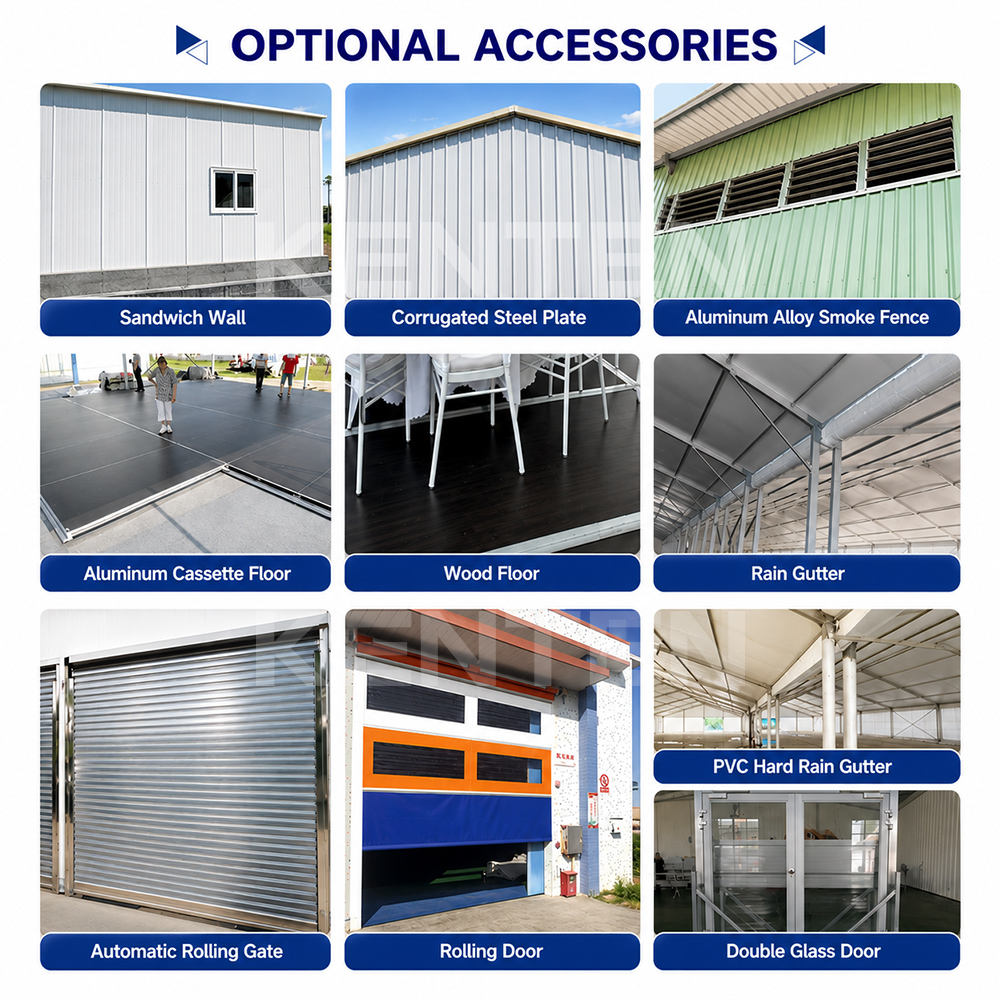
- Sidewall and door installation
- Gutter and drainage connection
- Lighting and HVAC integration
Aluminum Warehouse Tent vs. Traditional Warehouse: The Showdown
| Factor | Aluminum Warehouse Tent | Traditional Warehouse |
|---|---|---|
| Deployment Time | 3–14 days | 6–18 months |
| Cost per m² | $35–$120 | $400–$800+ |
| Foundation Required | Minimal / none | Full concrete slab |
| Relocatable | ✅ Yes | ❌ No |
| Expandable | ✅ Modular extension | ❌ Difficult/expensive |
| Permit Complexity | Low–Medium | High |
| Column-Free Interior | ✅ Full clear span | ✅ (if designed that way) |
| Lifespan | 15–25 years | 50+ years |
| Maintenance | Low (membrane replacement) | Medium–High |
| Capital Commitment | Low | High |
| Suitable for Leased Land | ✅ Perfect fit | ❌ Usually not |
How to Choose the Right Aluminum Warehouse Tent
Ask yourself these five questions before contacting a supplier:
- What span do I need? Measure your largest equipment (forklifts, trucks, cranes) and add clearance margins. Most operations need 15–25m spans; heavy industry may need 30–60m.
- What is the local wind/snow load? Check your local building code. Coastal areas and northern climates need higher engineering specs.
- Do I need climate control? If storing temperature-sensitive goods, specify insulated double-layer membranes and HVAC compatibility upfront.
- Who will install it? Professional installation is strongly recommended. DIY assembly risks structural failure and void warranties.
Maintenance: Keeping Your Warehouse Tent in Top Shape
One of the biggest advantages of aluminum warehouse tents is their minimal maintenance burden:
- Clean the membrane biannually with low-pressure water and mild detergent to prevent algae, dirt buildup, and UV degradation
- Inspect tension cables and hardware seasonally—re-tension after extreme weather events
- Check drainage and gutters regularly to prevent water pooling on the roof
- Inspect aluminum joints and bolted connections annually for any loosening or galvanic corrosion (rare but possible when in contact with dissimilar metals)
- Plan membrane replacement at 8–12 years—it’s a predictable, budgeted expense, not an emergency
Frequently Asked Questions
Do I need a building permit for an aluminum warehouse tent?
Requirements vary by jurisdiction. Many areas classify fabric tent structures as “temporary” or “industrial equipment” with simplified permitting. Permanent installations may require full permits. Always check local zoning and building codes. Reputable suppliers typically offer permit support as part of their service.
Can an aluminum warehouse tent handle heavy snow?
Yes. Aluminum warehouse tents can be engineered for specific snow load capacities (typically 0.5–1.5 kN/m²). In heavy-snow regions, specify a steeper roof pitch and reinforced trusses. Always provide local climate data to your supplier during the engineering phase.
How wind-resistant are aluminum warehouse tents?
Standard designs typically handle 80–120 km/h winds. For hurricane-prone or coastal areas, upgraded designs can achieve wind ratings up to 160 km/h. Proper anchoring (ground anchors or concrete footings) is critical to achieving rated wind performance.
Can I add insulation or climate control?
Absolutely. Options include:
- Double-layer insulated membranes (air-inflated or foam-core) for thermal separation
- HVAC integration for heated/cooled storage
- Evaporative cooling for large, well-ventilated operations
- Dehumidification for moisture-sensitive goods
What can I store inside an aluminum warehouse tent?
Almost anything. Common storage uses include:
- Pallets, boxed goods, and general inventory
- Machinery and industrial equipment
- Vehicles and construction materials
- Agricultural products and produce
- Textiles, paper, and moisture-sensitive goods (with climate control)
- Hazmat/chemical goods (verify with your supplier on fire-rated membranes)
How long does shipping take for a warehouse tent?
Production: 10–20 working days after order confirmation Shipping: 15–35 days by sea freight (international); 5–15 days by air freight (urgent)
Is an aluminum warehouse tent suitable for long-term use?
Yes. With a 15–25 year frame lifespan and replaceable membranes, aluminum warehouse tents are a viable semi-permanent storage solution. For operations that need a long-term (10+ year) facility on owned land, a conventional warehouse may offer better lifetime value—but aluminum tents remain the clear winner for leased sites, growing businesses, and seasonal operations.
Is an Aluminum Warehouse Tent Right for Your Business?
Aluminum warehouse tent structures are the right choice when:
- You need additional storage capacity within weeks, not months
- You’re operating on leased land and can’t build permanently
- You face predictable seasonal peaks (Q4 e-commerce, harvest season, etc.)
- You’re testing a new market or location and want to validate demand before committing
- Your business is growing fast and fixed infrastructure can’t keep pace
- You need emergency storage after a supply chain disruption or natural disaster
- You want to avoid the debt and commitment of permanent construction
If any of these scenarios sound familiar, an aluminum warehouse tent isn’t just a backup plan—it’s probably the smartest move you can make.
Ready to Get Started?
📧 Contact us today for a custom quote on your aluminum warehouse tent. 🌐 Get a Free Consultation
We’ll help you specify the right span, wind/snow ratings, and configuration for your operation—usually with a detailed engineering proposal within 24 hours.